How long does the assessment take?
Most users complete their initial Enterprise Risk assessment in about 2 hours. The assessment is self-paced — you can pause and resume at any time. No data collection or preparation is required before you start; the platform guides you through what it needs to know about your organization.
What risk domains does the Enterprise Risk Program cover?
The program is built around three core domains — people, process, and technology — covered in every assessment, and extends across a much broader set of risk domains based on relevance to your organization. Depth of analysis in each area is calibrated to your organization's specific profile — industry, size, and geography.
What compliance frameworks does the Enterprise Risk Program map to?
Framework mappings are included in the Practitioner Report for every finding: CIS Controls v8, COBIT 2019, COSO ERM 2017, GDPR, ISO 22301:2019, ISO 27001:2022, NIST CSF 2.0, NIST SP 800-53, NIST SP 800-171, PCI DSS v4.0.1, SEC Cyber Disclosure Rules 2023, SOC 2 (2017), and SOX.
What's the difference between Enterprise Risk and VeloRisk's other programs?
Enterprise Risk is the broadest program — it covers your full risk landscape across all organizational domains. The specialized programs (Fraud, AML/CFT, AI Risk) go significantly deeper in their specific domains but don't cover the broader enterprise picture. Many organizations run Enterprise Risk as the strategic baseline and add domain programs on top. A financial institution might pair it with AML/CFT and Fraud; a technology company building AI systems might pair it with AI Risk.
What's the difference between an enterprise risk assessment and a security or IT risk assessment?
Security and IT risk assessments focus on technical controls, vulnerabilities, and cybersecurity posture. Enterprise risk assessment is broader: it covers strategic, operational, financial, compliance, and technology risks across the full organization. Technology and cybersecurity risk is one domain within the Enterprise Risk Program — important, but not the whole picture.
Who should own the Enterprise Risk assessment internally?
Typically the CRO, CISO, VP of Compliance, General Counsel, or whoever carries board-level accountability for risk. The assessment is designed to be initiated and owned by the person who would present risk posture to the board or audit committee — with contributions from domain owners across IT, legal, HR, finance, and operations.
Is this designed for board reporting?
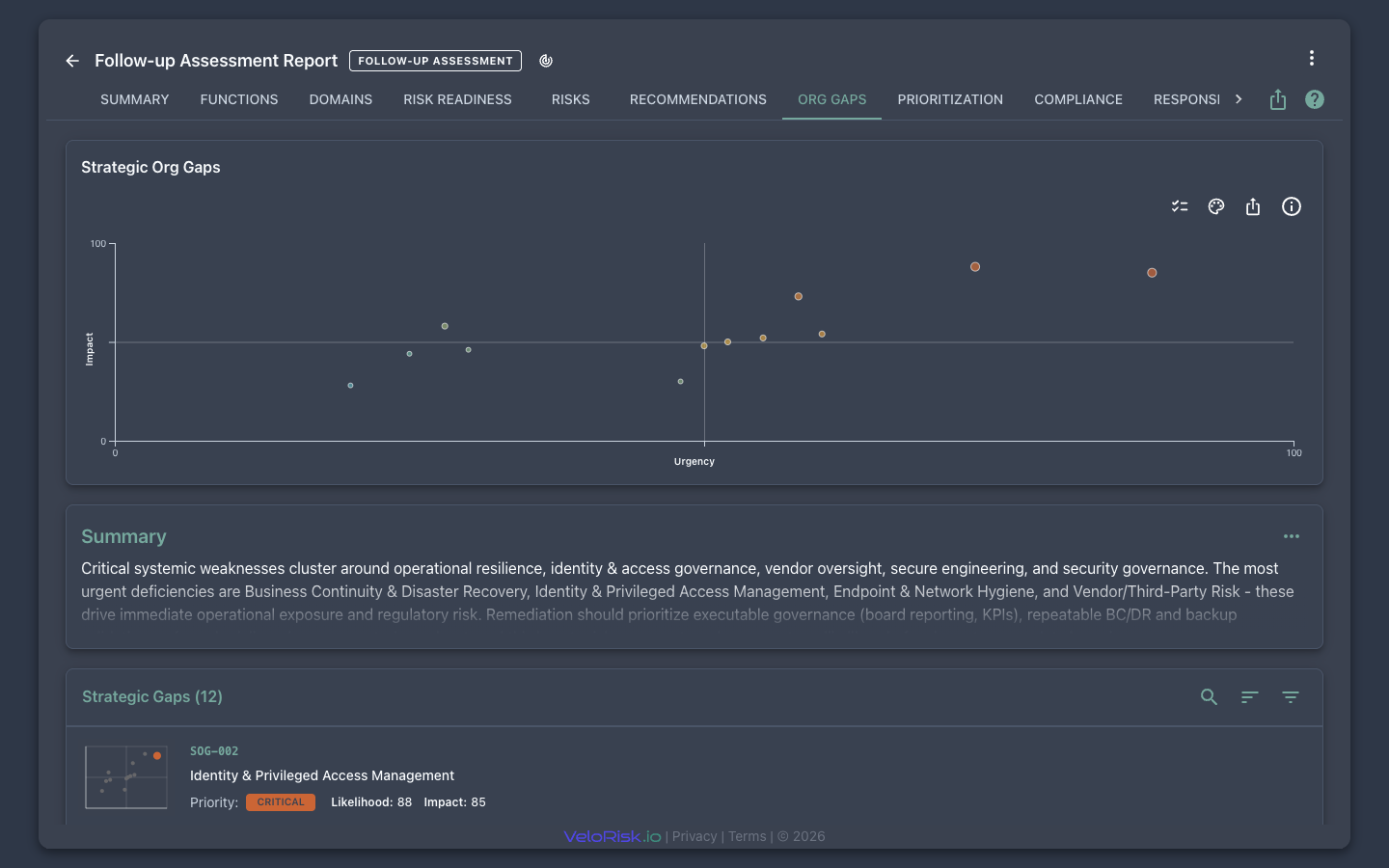
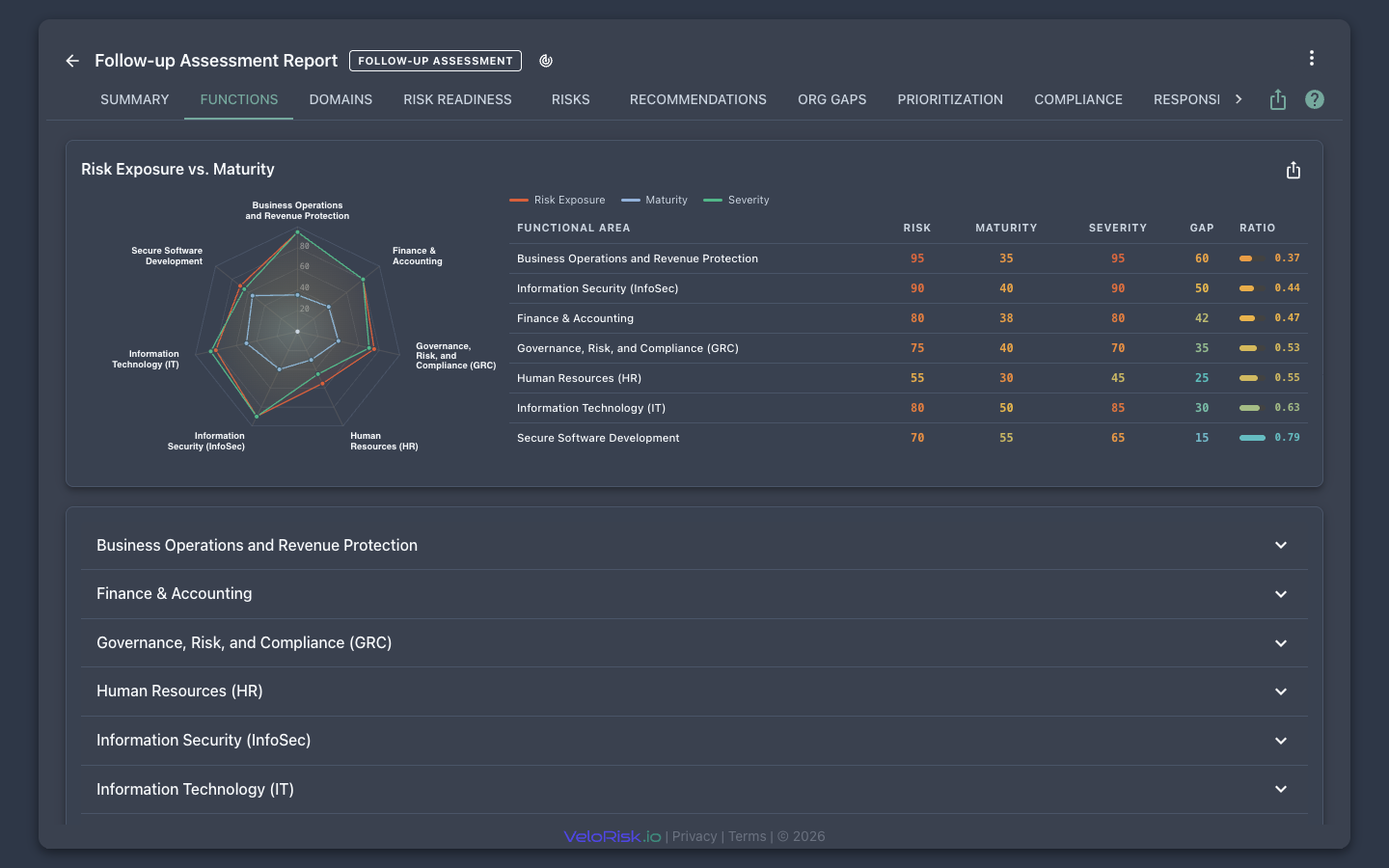
That's the primary use case. The Executive Report is built for board and audit committee presentation — it presents risk posture, maturity benchmarking, and strategic priorities in a format that requires no translation or additional preparation. The Practitioner Report is the working document your team uses internally.
Can this serve as documentation for M&A due diligence or regulatory examination?
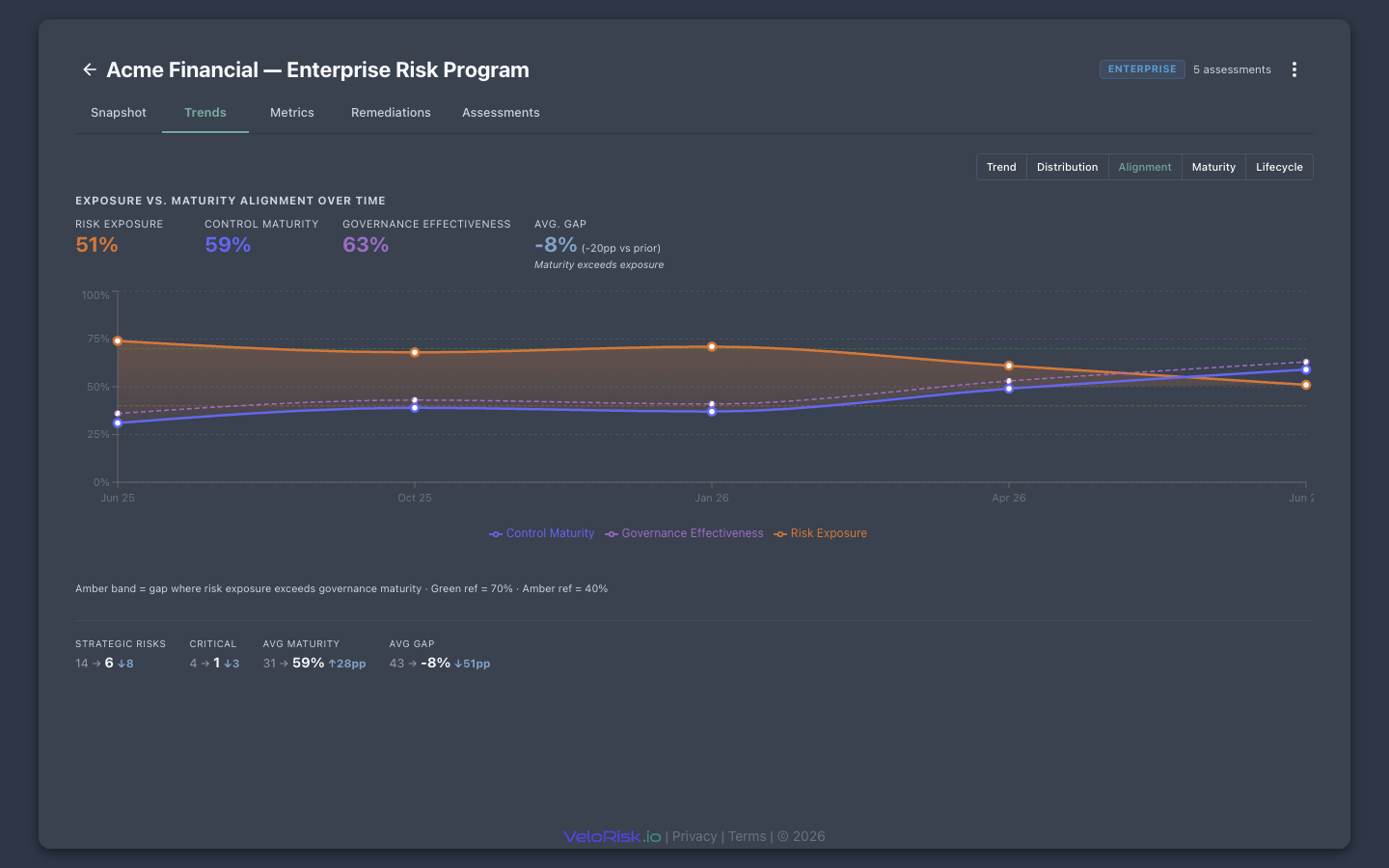
Yes — two of the most common high-stakes use cases. Acquirers and PE firms evaluate risk program maturity as part of diligence; regulators expect documented, current risk programs. The Executive and Practitioner Reports provide structured, dated documentation that demonstrates your program is active and defensible. Organizations running the program continuously can show a track record of assessment and remediation, not just a point-in-time snapshot.
We already use a GRC platform like Archer, MetricStream, or ServiceNow GRC. Why do we need VeloRisk too?
VeloRisk isn't a GRC replacement — it feeds one. A GRC platform tracks whether assigned work got done: control owners, due dates, a heat map that gets refreshed on a schedule. It doesn't generate the strategic picture of what should be tracked or whether your actual risk exposure is going down. VeloRisk runs that assessment on demand and produces prioritized findings you load directly into your existing GRC tool.
How does this relate to our existing risk register?
VeloRisk generates a risk register from your assessment findings — ready to import into your GRC tool, spreadsheet, or risk management system. You own the output. Most organizations bring it directly into their existing tools for ongoing tracking and remediation management.
General questions about the platform, security, pricing, and reports? See the full FAQ →